The ChatGPT You Use Isn't the ChatGPT the API Returns
Most AI visibility tracking asks ChatGPT through the API. Your buyers use the app. We ran both on the same prompts. They disagreed.
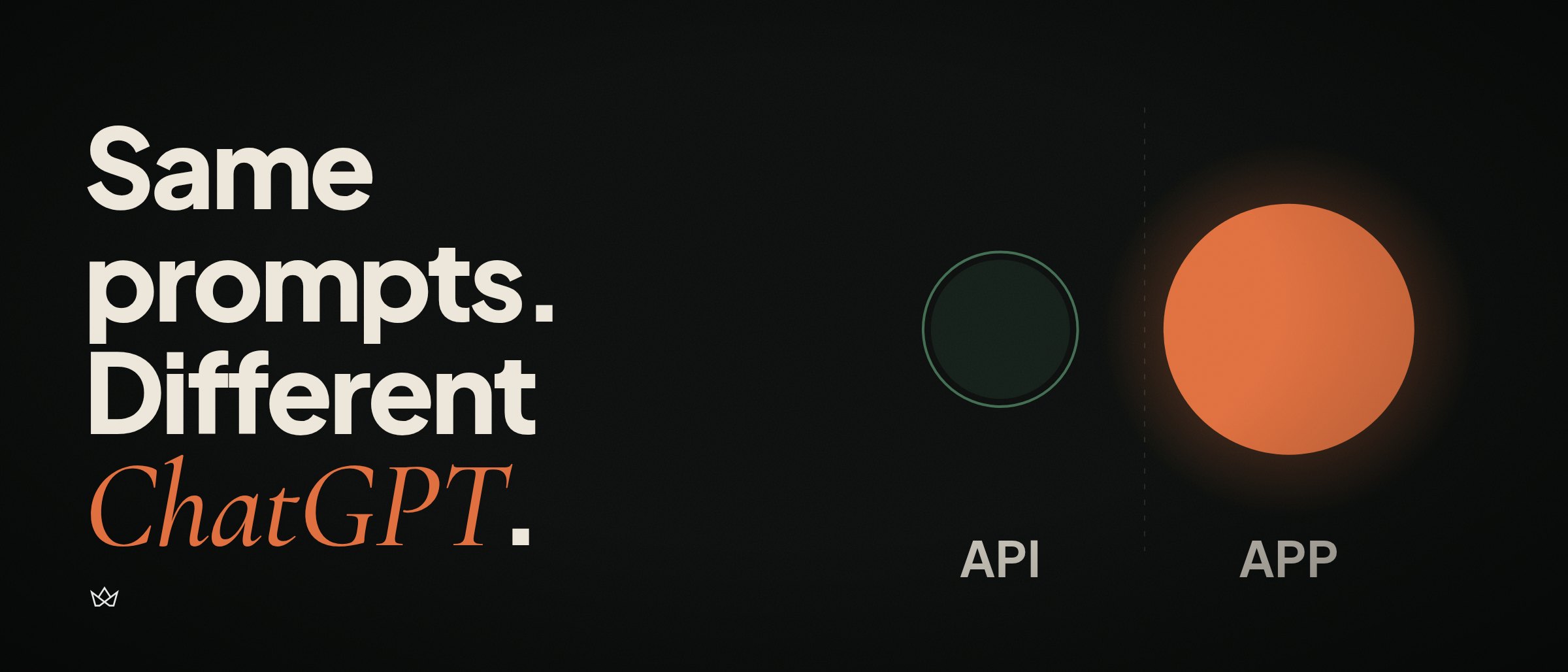
The easy way to measure what ChatGPT says about a brand is to ask it through the OpenAI API. It's fast, cheap and scriptable. We did it that way too.
Your buyers don't use the API. They use the app. The app has memory, decides for itself when to search the web, shows shopping cards, and picks a model based on the user's plan. The API has none of that unless a developer builds it in.
So we ran both on the same prompts, on the same day, and scored them with the same code. They didn't agree.
TL;DR
The test
We took 55 prompts we track for one B2B software brand, the same kind of buyer questions you'd ask when shopping for a tool. On 7 August 2026 we ran each prompt four ways:
| How we asked | Brand mentioned | Rate | Answers with sources |
|---|---|---|---|
| API, no web search | 8 of 55 | 14.5% | 0 of 55 |
| API, web search tool on | 8 of 55 | 14.5% | 28 of 55 |
| ChatGPT app, default | 13 of 55 | 23.6% | 15 of 55 |
| ChatGPT app, search forced | 21 of 55 | 38.2% | 55 of 55 |
Every answer was scored by the same production code, against the same competitor list. The only thing that changed was where the answer came from.
Two things stand out.
The API's positives were a strict subset of the app's. Every prompt where the API named the brand, the app named it too. The app found it on more prompts. Comparing search against search, 13 prompts disagreed and all 13 favoured the app (McNemar exact test, p = 0.00024). Comparing default against default, the gap was 5 prompts, which is suggestive but not significant on its own (p = 0.06). Turning on search in the API bought nothing. With the tool enabled, only 28 of 55 calls retrieved anything, and the mention rate didn't move. It also cost about 400 times the input tokens, because retrieved pages are billed as input. Expensive, and useless here.The app's answers were also longer. On the prompts where only the app named the brand, its answers ran 5,962 characters against the API's 3,297, and 4,609 against 2,667. Longer answers name more vendors. A brand that sits a little further down the pecking order makes the app's longer list and misses the API's shorter one. That's our working explanation, and it fits another detail: when the brand did appear in the app, it ranked slightly lower, around 3.3 against 2.6. It was further down a longer list, but it was on the list.
What actually decides it: whether ChatGPT searches
The app chooses when to search the web. OpenAI's help pages say it plainly: ChatGPT "may search the web automatically when your question would benefit from current information."
That choice turns out to be the biggest single predictor of whether a tracked brand shows up. Across 710 app answers in our production data, spread over several brands:
| Answers | Tracked brand mentioned | Average length | |
|---|---|---|---|
| ChatGPT searched | 511 | 18.7% | 6,911 characters |
| ChatGPT didn't search | 199 | 1.5% | 4,182 characters |
It held for each brand separately, too: 0 to 3% unsearched against 15 to 21% searched.
There's a catch, and it matters. The app doesn't search at random. It searched on 98.6% of commercial prompts, the "best X for Y" and "X vs Y" kind, and on about 60% of the rest. Commercial prompts are also where brands get named most. So part of that gap is the type of question, not the search.
We checked the prompts where the app searched on some runs and not on others. Same prompt, both outcomes: 20.0% mentioned when it searched, 4.1% when it didn't. The effect survives, though the hits come from a handful of prompts, so read it as a direction rather than a precise size.
The practical point stands either way. An API call without search looks like the app's unsearched answers, and the app's unsearched answers almost never name the brand.
The number that moved on its own
One more thing we learned the hard way. The API has an alias, chat-latest, which OpenAI describes as pointing "to the latest Instant model currently used in ChatGPT", with a snapshot that "will be regularly updated".
In July, the model behind the alias we were using changed. For the brand in our test, measured visibility fell from about 30% to about 11% over a few weeks. The lift from web search went from 49 points to under 3.
Nothing we could see about the brand changed in those weeks. The instrument did. And because the API returned only the alias name, nothing in the data said which model had answered.
If you track AI visibility through the API, a sudden move in your ChatGPT numbers can be OpenAI swapping a model, not your market shifting.
The honest part
We also compared the two surfaces more broadly: 70 prompts that had API answers from June to August and app answers from August to September. That comparison went the other way. The API mentioned the tracked brand 18.0% of the time, the app 10.1%.
It isn't a fair fight. The months differ, most of the API answers came from a model that has since been retired, and brands' real positions can move over three months. The controlled test is the stronger evidence. But it rules out the tidy headline "the app always shows you more".
What holds up across everything:
Why they differ
From OpenAI's own documentation (checked 29 September 2026):
One more reason is probable but unsourced: the app likely runs its own instructions around the model, which the API doesn't. OpenAI doesn't document it, so treat it as likely, not confirmed.
What we changed
In August we moved our ChatGPT measurement from the API to the consumer app. It's slower (35 to 50 seconds an answer, against 7 to 10 through the API) and it meant a break in our own history. It measures the thing your buyers actually see, which the API doesn't.
It's still not a perfect copy of any one person's ChatGPT. We see a fresh, logged-out, US session. A real buyer with years of memory and custom instructions sees their own version. Nobody can measure that from the outside, including us.
What to do about it
FAQ
Does the ChatGPT API give the same answers as the ChatGPT app?
No. In our test of 55 prompts on the same day, scored the same way, the app mentioned the tracked brand in 23.6% of answers by default and 38.2% with search forced, against 14.5% through the API. The app adds memory, automatic search, location and shopping features the API doesn't have by default.
Does turning on web search in the OpenAI API make it match ChatGPT?
Not in our test. Enabling the API's web search tool left the brand's mention rate unchanged at 14.5%, and only about half of those calls retrieved any sources.
Why does ChatGPT mention some brands only sometimes?
Largely because of search. In our production data, answers where ChatGPT searched the web named the tracked brand 18.7% of the time, against 1.5% when it answered from memory alone. ChatGPT searches almost every time on "best X for Y" questions and less often on others.
Why did my ChatGPT visibility suddenly drop?
Check the measurement before the market. OpenAI updates the model behind its API aliases, and in our data one such change cut a brand's measured visibility from about 30% to about 11% with no change in the brand itself.
Which ChatGPT does Renown measure?
The consumer app, since August 2026: a fresh, logged-out, US session, with ChatGPT deciding for itself when to search.
Method: the controlled test used 55 prompts for one B2B software brand, one run per prompt per method, on 7 August 2026, US English. The four methods were scored by the same production analyzer against the same competitor list. Production figures come from 710 consumer-app answers (August to September 2026) and 584 API answers (June to August 2026) across several brands, and are observational. Brand names are withheld. Percentages from samples this size carry roughly ±10 points of uncertainty; the direction of the controlled result is robust, the exact gap is not.
Related Articles
Same Question, Different Winners: How Often AI Engines Disagree
Ask ChatGPT, Claude, Perplexity, Gemini and Google the same question in the same week. They name the same top brand less than half the time.
What ChatGPT Actually Searches When You Ask It a Question
You ask ChatGPT one question. It runs three searches you never see. They don't look like your question, and half of them name vendors you didn't.
Six Questions to Ask Your AI Visibility Data
A score is a thermometer. It tells you there's a fever. Six questions that tell you why, and what to do about it.


