Same Question, Different Winners: How Often AI Engines Disagree
Ask ChatGPT, Claude, Perplexity, Gemini and Google the same question in the same week. They name the same top brand less than half the time.
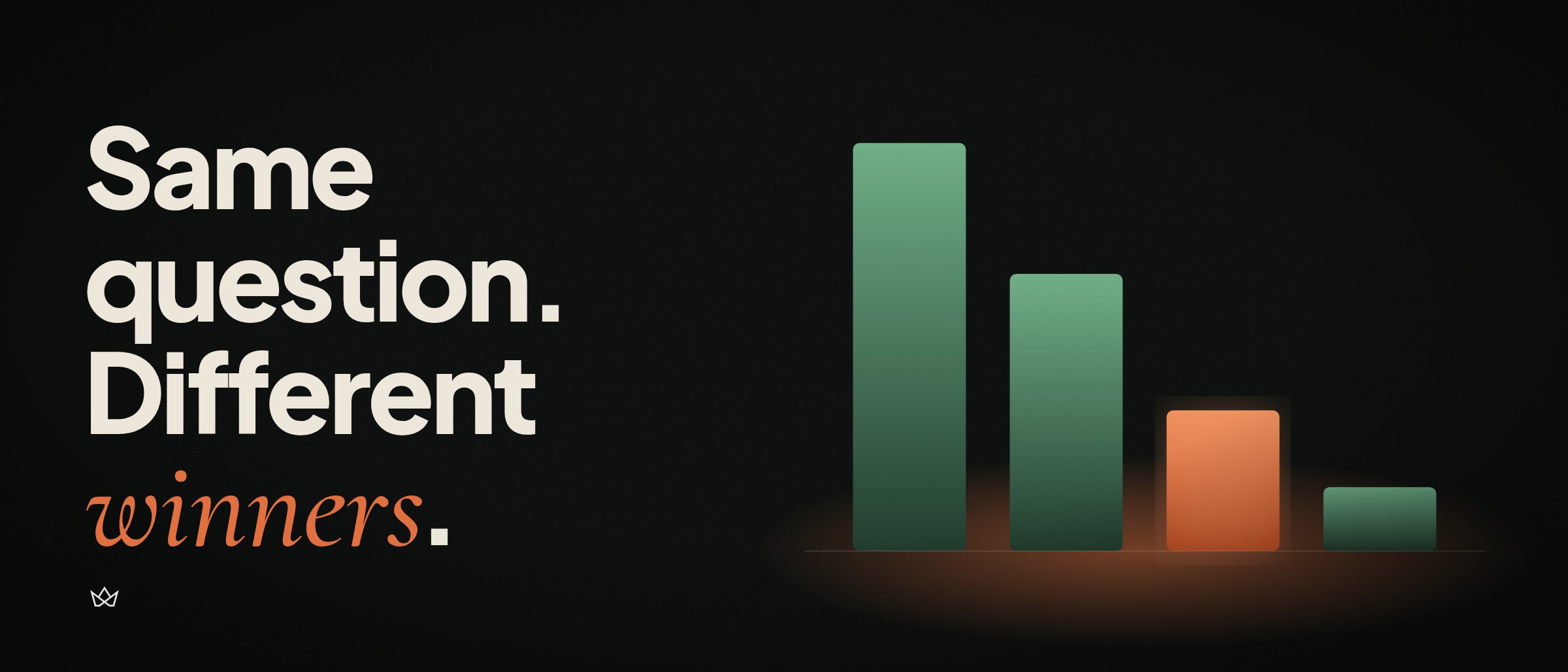
"AI recommends us" is a sentence people say as if AI were one thing. It isn't. There's ChatGPT, Claude, Perplexity, Gemini, Google's AI Overviews, and they were built by different companies, trained on different data and fed by different search indexes.
So we checked how often they actually agree. Same question, same week, different engines. Who comes out on top?
Usually, someone different.
TL;DR
How we measured it
From July to September 2026, we asked around 170 buyer-style questions to six AI surfaces: the ChatGPT app, ChatGPT through the OpenAI API, Claude, Gemini, Perplexity and Google AI Overviews. That's 2,106 answers, keeping one answer per question, engine and week.
For each answer we recorded which brands it named and which it named first. We only detect the brands we track for a question: the brand itself plus its competitor list, 138 to 249 names depending on the brand.
The questions come from three brands we track, one of them our own, all in B2B software. That's a small base, and we flag below where a number rests on one or two brands. No brand is named here.
Engines rarely agree on the winner
Take any two engines that answered the same question in the same week, where both named at least one tracked brand. How often did they put the same brand first?
45.5%, across 862 pairs.Widen it to every engine that answered:
| Engines answering the same question that week | All agree on the top brand |
|---|---|
| 2 or more | 23.1% |
| 4 or more | 10.5% |
When four or more engines all named a brand, they named 2.2 different winners on average.
Some pairs got along better than others, from under 30% agreement to around 60%. We're not publishing a league table of which engines agree, because several pairs rest on only one or two brands' questions. The overall picture holds up. The per-pair ranking doesn't, yet.
Most brands get named by one engine and nobody else
Forget the winner. How much do the lists of brands even overlap?
Not much. When two engines answered the same question in the same week and both named something, the average overlap was 0.39 on a scale where 0 means no brand in common and 1 means identical lists. One pair in five shared no brand at all.
And 70% of brand appearances came from only one engine. For a given question in a given week, most brands that got named at all were named by exactly one engine.
For the tracked brand itself: on questions where at least one engine mentioned it, every engine that answered did so only 40.5% of the time.
Is this just noise?
Fair question. AI answers vary from run to run. If one engine disagrees with itself as much as it disagrees with the others, "engines disagree" means nothing.
So we measured that too. The same engine, asked the same question twice within seven days, kept the same top brand 67% of the time.
That's the baseline. Engines agree with each other at 45.5%, well below the 67% at which each agrees with itself. Engines really do disagree with each other.
The 67% is a warning on its own, though. One engine changes its answer about one time in three, a week apart, same question. Google AI Overviews was the least stable, at 49%. Over a month or more, agreement fell to 40%, though that also picks up model and prompt changes, and rests on two brands.
Every brand has a favourite engine
For each of the three brands, we compared the mention rate on its best engine with its worst.
Three brands is three data points, not a law. But it's the pattern you'd expect if the engines really are reading different sources. There's no single "AI" to be visible in. There are several, and you can be doing well in one and poorly in the next.
The engines also talk differently
Answers didn't just name different brands. They named different numbers of them. On average, across the tracked lists:
| Engine | Tracked brands named per answer |
|---|---|
| ChatGPT (API) | 3.6 |
| Claude | 3.3 |
| Google AI Overviews | 2.9 |
| ChatGPT (app) | 2.3 |
| Perplexity | 1.5 |
| Gemini | 0.7 |
Treat this as rough. The engines didn't all answer the same questions, the Gemini and Claude figures come from one and two brands, and we only count brands on our lists. An engine that likes naming brands we don't track looks quieter here than it is.
The point survives the caveats: some engines hand buyers a long shortlist, some a short one. A short list is harder to get on.
What to do about it
FAQ
Do ChatGPT, Claude, Gemini and Perplexity recommend the same brands?
Often not. In our data, two engines answering the same buyer question in the same week put the same brand first 45.5% of the time. All engines agreed on the top brand only 23.1% of the time.
Is AI visibility the same across every AI engine?
No. For each brand we tracked, its best engine mentioned it 1.4 to 2.9 times as often as its worst, and a different engine was best for each brand.
How consistent are AI answers from one week to the next?
Less than you'd hope. The same engine asked the same question within a week kept the same top brand 67% of the time. Google AI Overviews was the least stable at 49%.
Why do AI engines recommend different brands?
They're trained on different data, search different indexes and decide differently when to search at all. Our data can't say which factor matters most, but the gap between engines is larger than the run-to-run noise within any one engine.
Should I track AI visibility per engine?
Yes. Most brand appearances in our data came from a single engine, so a blended score can look healthy while one engine barely mentions you.
Method: about 170 English buyer-intent questions from three tracked B2B software brands (one is Renown's own), asked to six AI surfaces between 1 July and 28 September 2026. One answer kept per question, engine and week: 2,106 answers. "Top brand" means the tracked brand or listed competitor that appears first in the answer, which is not always the one recommended. Only brands on each question's tracked list are detected. Several engine-pair figures rest on one or two brands and are not reported individually. No brand is named.
Related Articles
The ChatGPT You Use Isn't the ChatGPT the API Returns
Most AI visibility tracking asks ChatGPT through the API. Your buyers use the app. We ran both on the same prompts. They disagreed.
What ChatGPT Actually Searches When You Ask It a Question
You ask ChatGPT one question. It runs three searches you never see. They don't look like your question, and half of them name vendors you didn't.
Six Questions to Ask Your AI Visibility Data
A score is a thermometer. It tells you there's a fever. Six questions that tell you why, and what to do about it.


