91 brands, 3 categories, 1 pattern: AI search is winner-take-most
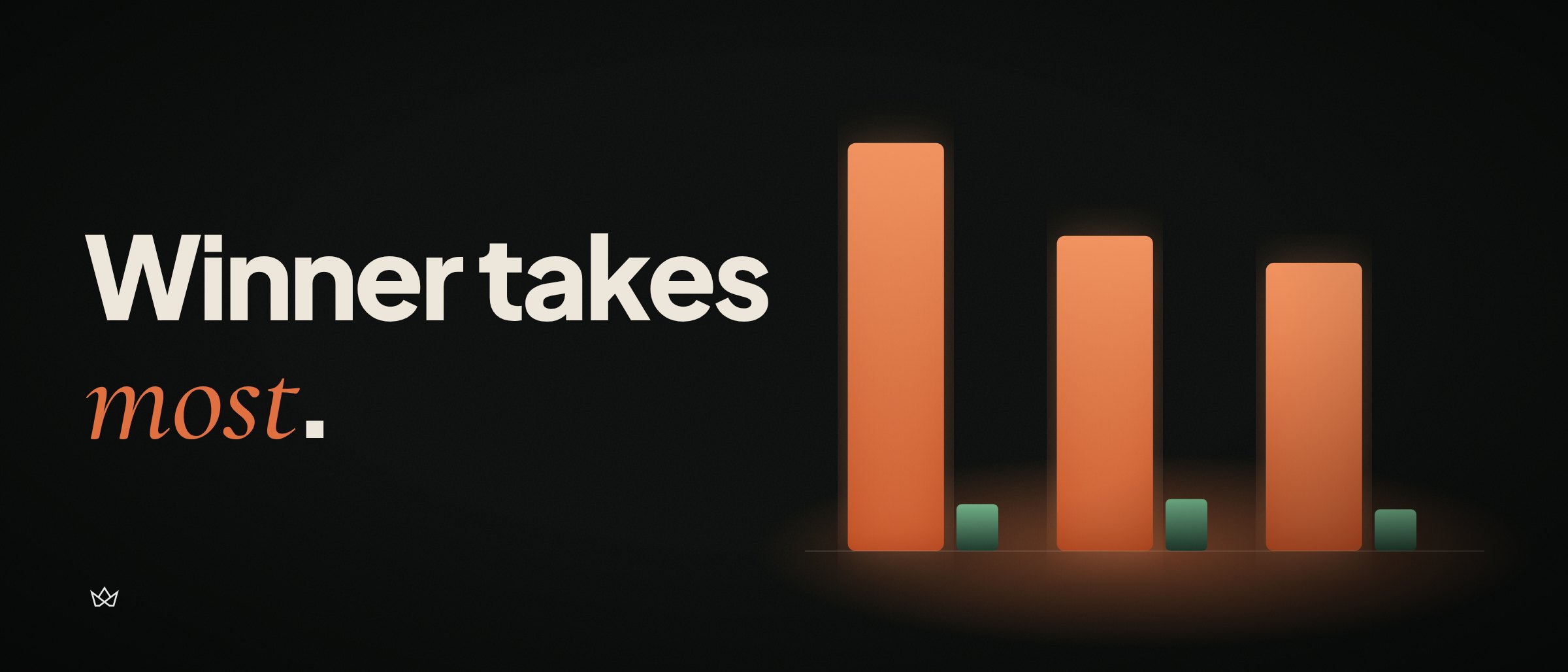
The #1 brand captures 55-78% of AI visibility. The median sits at 8-10%. The rest fight over scraps. AI search is a power law, not a bell curve.
TL;DR
We've now published three AI visibility reports covering observability tools, outbound sales platforms, and AI coding assistants. 91 brands. 10 AI models. 300 prompts. Over 3,000 responses analyzed. The same pattern shows up every time: the top brand in each category captures a disproportionate share of AI visibility, the median brand is functionally invisible, and there's no long tail.
The pattern across all three categories
| Category | #1 Brand | #1 Score | Median | Gap |
|---|---|---|---|---|
| Observability | Datadog | 78.3 | 9% | 69 pts |
| Outbound Sales | Apollo | 60.5 | 10% | 50 pts |
| AI Coding Tools | Copilot | 55.3 | 8% | 47 pts |
The #1 brand captures 55 to 78 percent of the visibility. The median sits at 8 to 10 percent. The rest fight over scraps.
This is not a bell curve
In traditional search, you can rank on page 2 and still get some traffic. In a G2 comparison, being #5 still gets you clicks. AI search doesn't work that way. When someone asks ChatGPT what observability tool to use, the response typically names 3 to 5 brands. The #1 brand appears in nearly every response. The #15 brand appears in almost none.
AI search is closer to a power law than a normal distribution. Being "pretty good" at AI visibility gets you almost nothing. Being in the top 3 gets you into the majority of AI-generated recommendations. This is part of why the old SEO playbook doesn't transfer cleanly.
Why the same pattern repeats
Three structural forces drive winner-take-most in AI search.
The first is training data concentration. AI models learn from the same corpus of web content. If one brand dominates comparison articles, vendor-neutral reviews, technical documentation, and community discussions, that dominance gets baked into the model's weights. The next version of the model inherits the same bias, and the cycle compounds.
The second is citation accumulation. AI search engines that use web search in real time (ChatGPT, Perplexity, Claude) pull from sources they consider authoritative. The brands with the most comprehensive, frequently updated, well-structured content get cited. Once a brand's content becomes the canonical reference for a category, other content starts referencing it too. Citations compound the way backlinks did in early SEO.
The third is query concentration. Most AI search queries about tools are broad. "What are the best observability tools?" not "Compare SigNoz and Honeycomb for Kubernetes monitoring." Broad queries favor well-known brands. The long tail of specific, niche queries where smaller brands could compete makes up a small fraction of total AI search volume.
The training data cutoff creates a two-tier market
Brands that launched or gained significant traction after early 2024 face a structural disadvantage. Models trained on data from 2023 or earlier simply don't know these brands exist.
This shows up clearly in our data. Clay and Instantly in outbound sales, Claude Code and Codex in coding tools: all get nearly all their AI visibility from web-search-enabled models (ChatGPT, Perplexity, Claude). On training-only models (Gemini, DeepSeek, Mistral, Qwen), they're barely present.
The AI search landscape is not one leaderboard. It's two. One for established brands that benefit from historical training data. One for newer brands that can only be seen through real-time web search.
What to do with this data
If you're the #1 or #2 brand in your category, your job is maintenance. AI visibility compounds, and the training-data advantage you have today carries forward into the next generation of models. Don't take it for granted, but recognize your position is structurally defensible.
If you're in the middle of the pack, the gap to the top is likely larger than you think. Incremental content improvements won't close a 40-point visibility gap. You need to become the definitive reference for a specific slice of your category and expand from there.
If you're invisible, AI search is currently a competitor's distribution channel. The first step is knowing where you stand. The second is understanding which content sources AI models actually trust. The third is building content designed to earn citations from those models.
We built Renown to make this measurable. But regardless of what tools you use, the data from 91 brands across 3 categories says the same thing: AI search is winner-take-most, the window to establish your position is now, and most brands haven't started.
Observability report · Outbound Sales report · AI Coding Tools reportFrequently asked questions
What does "winner-take-most" mean in AI search?
The top brand in a category captures 55-78% of AI visibility while the median brand sits at 8-10%. AI responses name only 3-5 brands, so the leader appears in nearly every answer and everyone else is mostly absent. It's a power law, not a bell curve.
Why does the same pattern repeat across categories?
Three compounding forces: training-data concentration (dominant brands get baked into model weights), citation accumulation (authoritative content gets cited more, then referenced by others), and query concentration (broad questions favor well-known brands).
Can a mid-pack brand break into the top tier?
Not with incremental content. A 40-point gap doesn't close with a few posts. The realistic path is owning a specific, well-defined slice of the category as the definitive reference, then expanding outward.
Is the winner-take-most effect permanent?
The training-data advantage compounds, but it's not locked. Citation patterns and web-search visibility still shift with content investment, and each new model generation re-reads the web. The brands building presence now are positioning for the next cycle.
Renown is an AI visibility platform that tracks how AI models talk about your brand across ChatGPT, Claude, Gemini, Perplexity, and Google AI Overviews.
Related Articles
What ChatGPT Actually Searches When You Ask It a Question
You ask ChatGPT one question. It runs three searches you never see. They don't look like your question, and half of them name vendors you didn't.
Six Questions to Ask Your AI Visibility Data
A score is a thermometer. It tells you there's a fever. Six questions that tell you why, and what to do about it.
Ask Renown From Claude and ChatGPT
Your AI visibility data, answered by the AI you already use. Connect once, then ask in plain language.


