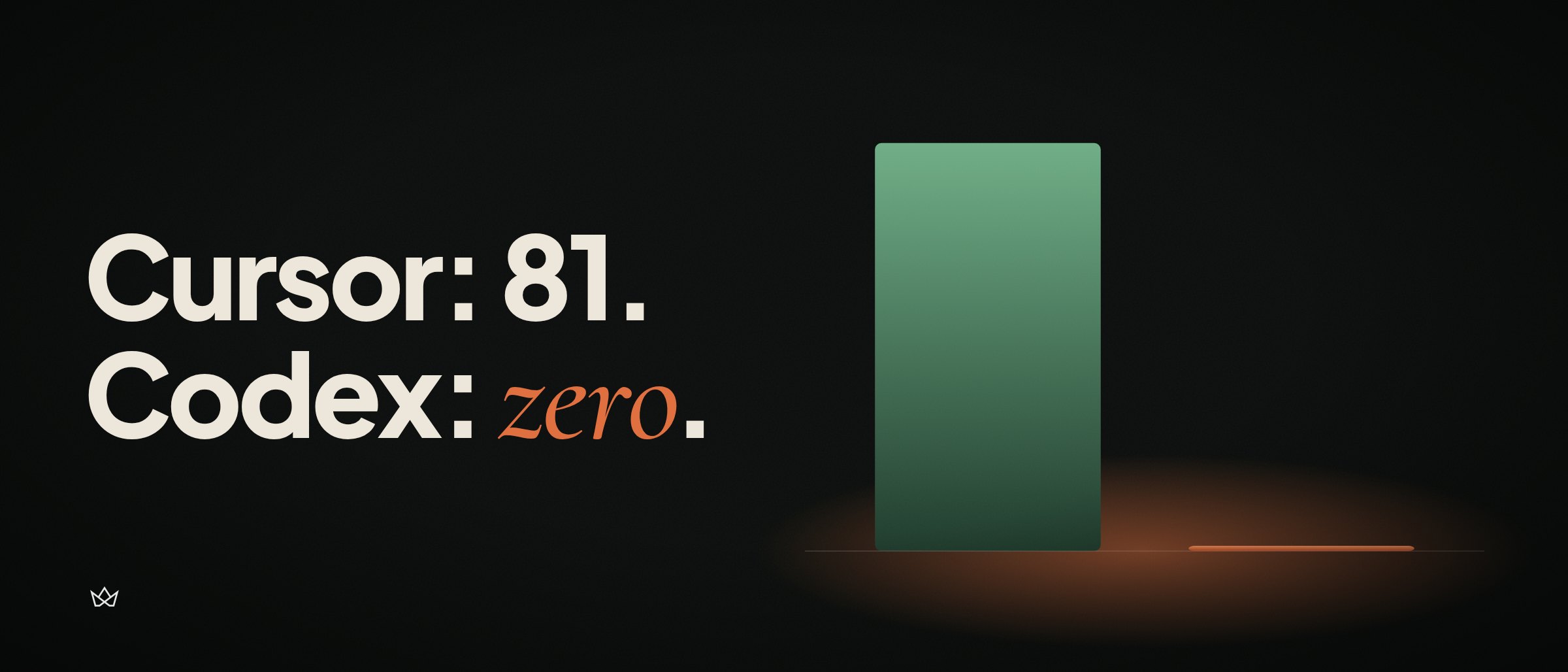
Grok mentions Cursor 81 times and Codex zero times. Corporate feuds are reshaping AI recommendations
Grok mentions Cursor 81 times. It mentions Codex, built by rival OpenAI, zero times. Every other model knows Codex exists. One model has a very specific blind spot.
TL;DR
We tested 10 AI models with 100 prompts about coding tools. Most produce broadly similar rankings. One stands out. Grok, built by xAI, mentions Cursor 81 times across our prompts and mentions Codex, built by OpenAI, zero times. Codex ranks #4 overall at 31.9 and appears on 9 of 10 models, so it's not obscure. Every other model that knows coding tools mentions it. Grok doesn't. xAI and OpenAI are direct competitors. Draw your own conclusion.
Is this intentional?
We can't say whether Grok's omission of Codex is deliberate engineering, a training-data artifact, or a byproduct of xAI's data curation process. What we can say is that xAI and OpenAI are direct competitors. The pattern is consistent across every prompt where Codex would be relevant. And no other model exhibits this specific blind spot.
The charitable interpretation is that Grok's training data was curated in a way that excluded or downweighted OpenAI-affiliated content. The less charitable interpretation is that competitive dynamics are influencing product recommendations.
Models generally don't self-promote
The Grok/Codex finding is notable precisely because it's an exception. Across all three of our reports, the broader pattern is that AI models don't aggressively push their parent company's products.
ChatGPT doesn't disproportionately recommend Codex. Claude doesn't disproportionately recommend Claude Code. In fact, ChatGPT mentions Claude Code more often than Claude itself does. The fear that AI models would become product-placement channels for their parent companies doesn't hold up in the data.
This is good news for the credibility of AI search as a discovery channel. If models were systematically biased toward their own products, the entire recommendation layer would be compromised. With the exception of the Grok/Codex pattern, that doesn't appear to be happening.
What this means for buyers
If you're researching tools through AI search, the model you use shapes what you see. Grok users will never see Codex recommended. ChatGPT users see a broad set of tools with no obvious self-promotion bias. Perplexity users get a search-engine-quality result. DeepSeek users see a 2023 version of the market.
The takeaway for buyers: consult more than one model. The takeaway for brands: your AI visibility depends not just on what you do, but on which models your potential buyers use and what biases those models carry. That's exactly why tracking visibility across every model, not just one, matters.
The full AI Coding Tools report includes model-by-model breakdowns showing how each AI surface sees the market differently.
Read the full AI Coding Tools reportFrequently asked questions
Does Grok really never mention Codex?
Across our 100 coding-tool prompts, Grok mentioned Codex zero times while mentioning Cursor 81 times. Codex ranks #4 overall and appears on 9 of the other 10 models, so the omission is specific to Grok.
Is the Codex omission deliberate?
We can't prove intent. It could be deliberate curation, a training-data artifact, or a side effect of xAI's data process. What's clear is that xAI and OpenAI are direct competitors and no other model shows this blind spot.
Do AI models favor their parent company's products?
Generally, no. ChatGPT doesn't over-recommend Codex; Claude doesn't over-recommend Claude Code. ChatGPT even mentions Claude Code more than Claude does. The Grok/Codex case is the exception, not the rule.
What should buyers do about model bias?
Consult more than one model. Each AI surface carries different biases and different training cutoffs, so a single model gives you a skewed picture of any category.
Renown is an AI visibility platform that tracks how AI models talk about your brand across ChatGPT, Claude, Gemini, Perplexity, and Google AI Overviews.
Related Articles
Six Questions to Ask Your AI Visibility Data
A score is a thermometer. It tells you there's a fever. Six questions that tell you why, and what to do about it.
Ask Renown From Claude and ChatGPT
Your AI visibility data, answered by the AI you already use. Connect once, then ask in plain language.
How AI Chooses Its Sources: 3,543 Citations, Analyzed
AI doesn't read your website. It reads Reddit, YouTube, Wikipedia, and a handful of independent blogs. We have the data: 3,543 citations across two engines and 60 questions.


