AI Overviews, AI Mode, and the Slow Death of the Click
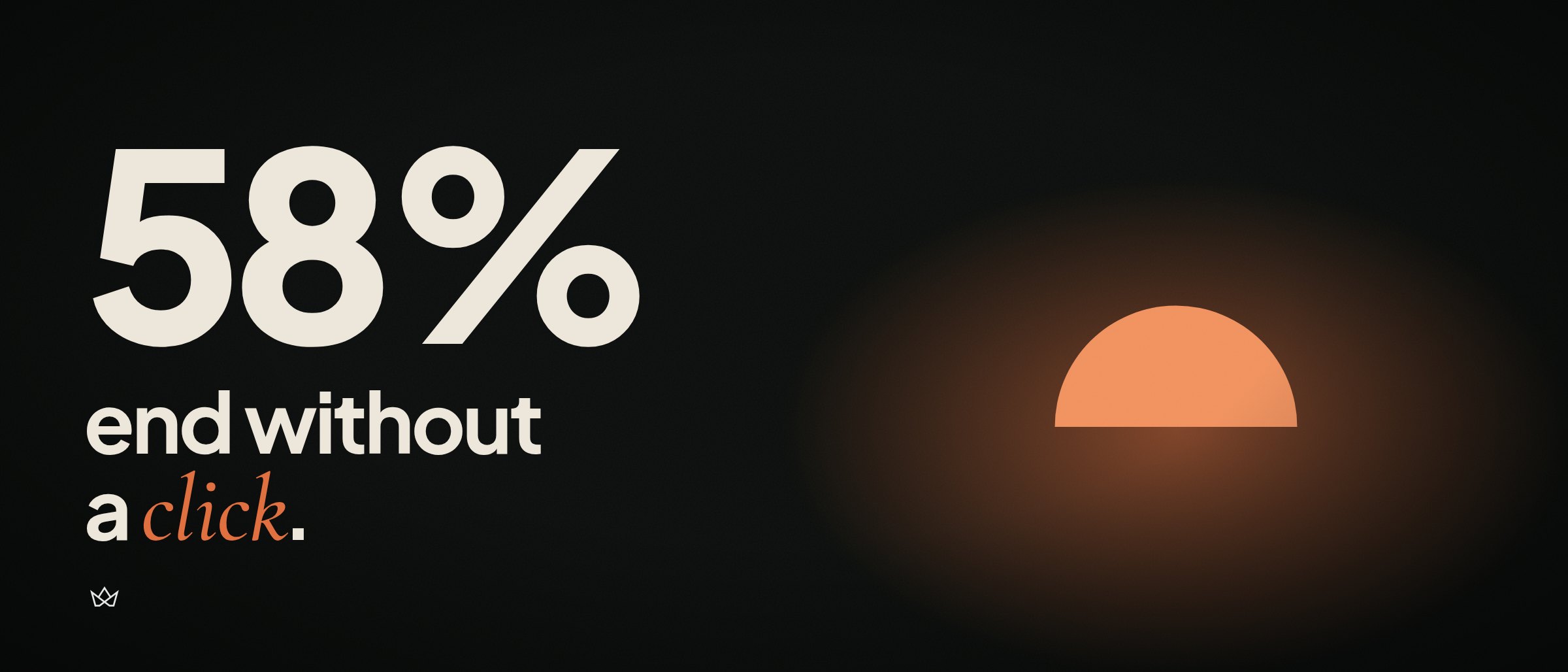
58% of Google searches now end without a click. Some publishers have lost 97% of their traffic. The company that wrote the original contract of the internet is rewriting it.
For twenty-five years, the basic contract of the internet went something like this: you make something good, a search engine helps people find it, they click through to your site, and you earn their attention. The whole apparatus of digital business, the advertising, the content marketing, the careful work of search optimization, rested on that click. The click was the currency. Everything was measured in clicks.
That contract is being rewritten, and the company doing the rewriting is the same one that wrote the original.
What Google is doing to Google
In May 2024, Google launched AI Overviews across the United States. These are AI-generated summaries that appear above the traditional search results, synthesizing information from multiple sources into a direct answer. The user gets what they need without scrolling, often without clicking anything at all.
The feature has expanded fast. AI Overviews now appear in over 200 countries and 40 languages. According to BrightEdge's year-long tracking, they trigger on roughly 48% of all search queries as of early 2026, up from 31% a year prior. That's a 58% increase in twelve months. In some verticals the saturation is extraordinary: 88% of healthcare queries, 83% of education queries, 82% of B2B technology queries, and 78% of restaurant queries now produce an AI-generated answer before the user sees a single link.
Then there's AI Mode. Where AI Overviews sit above the traditional results, AI Mode replaces them entirely. It's a conversational interface, powered by Gemini, that takes a query, breaks it into as many as 16 sub-queries simultaneously, searches across them, and synthesizes a single response with citations. There are no ten blue links. There is no page one. You get cited in the answer or you don't appear at all.
As of January 2026, Google connected the two experiences: users can now move straight from an AI Overview into a full AI Mode conversation, making it progressively easier to stay inside Google's AI layer rather than clicking through to the open web. The company describes it as "one fluid experience." For publishers, it's one more reason nobody visits.
The numbers
The data on what this means for traffic is no longer ambiguous.
Seer Interactive tracked 3,119 queries across 42 organizations over fifteen months. For queries where AI Overviews appeared, organic click-through rates fell 61%, from 1.76% to 0.61%. Paid click-through rates fell 68%. Even queries without AI Overviews saw organic CTR decline 41% year-over-year, likely because users are developing new habits across the board.The broader picture is consistent. 58% of all Google searches now end without a click. For queries that trigger AI Overviews specifically, the zero-click rate climbs to roughly 80-83%. Google search traffic to publishers fell by a third globally in the year to November 2025. Google Discover referrals dropped 21%.
Some publishers have been hit far harder. Digital Trends went from 8.5 million clicks a month from Google in March 2024 to 265,000 in January 2026, a decline of 97%. Wired lost 62% of its Google traffic. The Verge, HowToGeek, and ZDNet each lost more than 75%. These aren't small sites with thin content. These are established publications that played by the rules for years.
BrightEdge found that search impressions climbed 49% in the year following AI Overviews' launch. People are searching more than ever. They're just not clicking. The searches happen. The visits don't.The paradox of being cited
There's a strange consolation in the data. Brands cited inside AI Overviews earn 35% more organic clicks and 91% more paid clicks than those excluded from the summary. Being mentioned in the AI layer is better than not being mentioned, even in a world with fewer clicks overall.
But this creates a winner-take-most dynamic. If citations drive a disproportionate share of remaining clicks, and if the top 10 domains capture 46% of all ChatGPT citations in any given topic, then the distribution of traffic is concentrating, not spreading. The brands that get cited get more traffic. The brands that don't get cited lose it. The middle ground, the long tail that sustained millions of small publishers, is being hollowed out.
And here's the detail that makes this particularly difficult: AI Overviews and AI Mode cite different sources 87% of the time for the same query, despite both being Google products. Earning a citation in one feature doesn't mean you'll appear in the other. The landscape is fragmenting even within a single search engine.
Beyond Google: the migration to AI-native search
The click problem compounds when you account for the traffic that never reaches Google in the first place.
ChatGPT now accounts for roughly 20% of search-related traffic worldwide. Its 900 million weekly active users aren't all doing research, but a significant and growing share are using it as a search replacement. Perplexity handles over 700 million queries a month. Claude and Gemini each serve tens of millions of users. These platforms don't send traffic the way Google does. They answer questions. The whole interaction happens inside the interface.The total amount of searching people do has actually grown. Combined usage of search engines and AI platforms increased 26% worldwide over the past year. But the growth is all on the AI side, and AI interactions produce far fewer outbound clicks. The pie is bigger. The slice that reaches your website is smaller.
For businesses that depend on search traffic, this creates a disorienting math problem. Your potential audience is larger than ever. Your ability to reach them through familiar channels is shrinking.
What this means if you sell something
The implications differ depending on what kind of business you run.
If you're a publisher or content business, the threat is existential and immediate. Your content is being consumed without being visited. The value you create is being extracted and served to users inside someone else's interface. The old model of traffic-to-advertising is under structural pressure that no amount of SEO optimization can reverse. If you're a SaaS company or B2B vendor, the risk is subtler but significant. Your buyer's research phase is increasingly happening inside AI. By the time they land on your website, their consideration set may already be formed. If you weren't in the AI's recommendation, you're not in the conversation. The click you eventually get is downstream of a decision that was already made somewhere else. If you're in hospitality, local services, or consumer products, the shift is accelerating quickly. Restaurant queries trigger AI Overviews 78% of the time, up from 10% a year ago. Travel queries are among the fastest-growing categories for AI-generated results. When someone asks an AI where to eat, where to stay, or what to buy, the answer they get shapes their choice before they ever see your Google listing.In every case, the click is becoming a trailing indicator. The decision happens earlier, inside a system you can't see into, governed by signals you may not be tracking.
The question nobody wants to answer
Here is the uncomfortable thing. Google is doing this deliberately. AI Overviews and AI Mode are not accidents or side effects. They are the product strategy. Google is choosing to answer questions directly because it keeps users inside Google's ecosystem for longer, and positions Google to monetize attention in ways that ten blue links cannot.
The company is explicit about this. They frame it as a better experience for users, and for many queries, it genuinely is. Getting a synthesized answer to a straightforward question is faster and more convenient than scanning a list of links. Users like it. Usage keeps growing.
But the fact that it's better for users doesn't make it less disruptive for everyone else. The entire infrastructure of digital marketing, content publishing, and online commerce was built on the assumption that search would send people to websites. That assumption is weakening in real time.
What to do about it
We're past the stage where anyone can pretend this isn't happening. The question is what to do.
Accept the structural shift. Click-through rates from search are not going back to 2023 levels. Planning as though they might is a form of denial. Adjust your forecasts, your KPIs, and your expectations to reflect a world where search drives less traffic but where the traffic it does drive may be more qualified. Invest in being cited, not just ranked. The brands earning citations in AI responses get disproportionate benefits. This requires different content than what worked for traditional SEO: more specific claims, more structured data, more genuine expertise. Monitor your AI visibility across platforms. You cannot manage what you cannot see. Google Search Console tells you nothing about AI Mode citations. There is no equivalent for ChatGPT or Perplexity. Tools that track AI visibility across models are no longer optional for businesses that depend on discoverability. (This is what Renown does.) Diversify your discovery channels. If 20% of search-related traffic is already flowing through ChatGPT, treating Google as your only discovery channel is a concentration risk. Understand how your brand appears across every major AI platform and build a presence that's robust across all of them. Build direct relationships. The most resilient businesses will be the ones least dependent on any single discovery channel. Email lists, communities, referral networks, direct brand searches: these are assets that no algorithm change can take away. Every click you do get should be treated as an opportunity to build a relationship that doesn't depend on the next search result.The click isn't dead. But it's worth less than it was yesterday.
Search is not disappearing. People are searching more than ever. But the nature of what search produces is changing fundamentally, and the change favors the platforms over the publishers, the synthesizers over the sources, the brands that appear in AI answers over those that merely rank well.
The click still matters. It just isn't the starting point anymore. Increasingly, it's the last step in a journey that began and was mostly resolved inside an AI interface that your analytics dashboard cannot see.
Knowing what happens in that invisible step is no longer a luxury. It's the whole game.
Renown is an AI visibility platform that tracks how AI models talk about your brand.
Related Articles
Six Questions to Ask Your AI Visibility Data
A score is a thermometer. It tells you there's a fever. Six questions that tell you why, and what to do about it.
Ask Renown From Claude and ChatGPT
Your AI visibility data, answered by the AI you already use. Connect once, then ask in plain language.
How AI Chooses Its Sources: 3,543 Citations, Analyzed
AI doesn't read your website. It reads Reddit, YouTube, Wikipedia, and a handful of independent blogs. We have the data: 3,543 citations across two engines and 60 questions.


