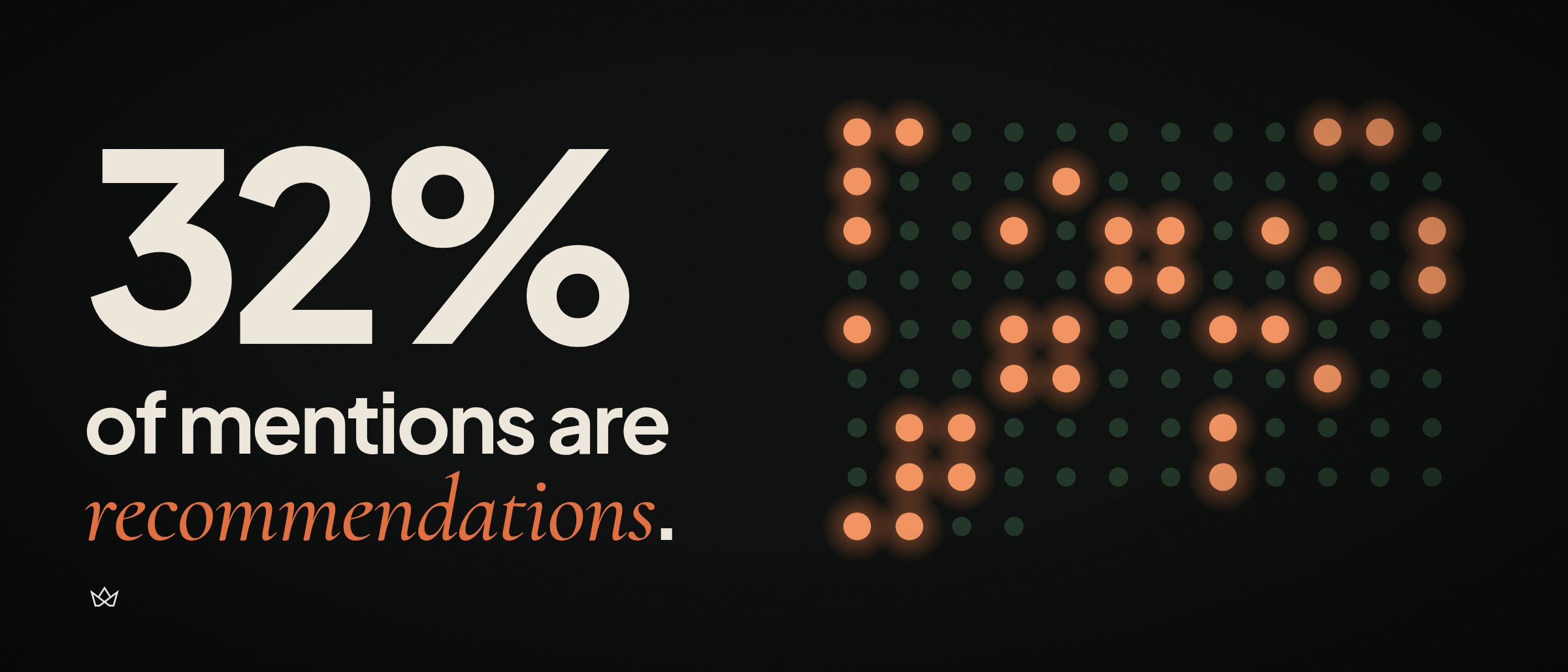
Lavender gets recommended 32% of the time it's mentioned. Apollo gets 21%. Why fewer mentions can mean more influence
Apollo: 645 mentions, 21% recommended. Lavender: 59 mentions, 32% recommended. Awareness and advocacy are different metrics, and they need different strategies.
TL;DR
In our outbound sales report, Apollo leads on total mentions with 645 across 1,000 AI responses, at a 21% recommendation rate. Lavender appears in just 59 mentions, but 32% of those are direct recommendations. When AI brings up Lavender, it's far more likely to say "you should use this" than "this exists." Mentions measure awareness. Recommendations measure advocacy. They're different metrics, and improving each takes a different strategy.
Mentions and recommendations measure different things
Total mentions measure awareness. How often does AI include your brand when discussing a category? Apollo dominates this metric because it's referenced in broad market overviews, comparison contexts, historical discussions, and direct recommendations alike.
Recommendation rate measures advocacy. Of the times your brand is mentioned, how often does the AI specifically recommend it as a solution? A high recommendation rate on a smaller mention count suggests AI models have a strong positive signal about your brand, even if that signal appears in fewer total responses.What drives a high recommendation rate
Lavender occupies a specific niche: AI-powered email coaching for sales teams. It's not a general-purpose outbound platform. It does one thing, and content about Lavender tends to be specific about what it does and who it's for.
AI models are better at recommending products when they have clear, specific use-case information. Broad platforms like Apollo get mentioned in many contexts but recommended less precisely, because the recommendation depends on the buyer's specific needs. Niche tools with well-defined use cases get recommended more consistently within their niche.
The strategic implication
If your brand is being mentioned but not recommended, the issue may not be awareness. It may be positioning. AI models need clear signals about when to recommend your product. That means content that's specific about use cases, buyer personas, and differentiation from competitors.
If your brand has a low mention count but high recommendation rate, your positioning is working. The opportunity is to increase the number of contexts where AI encounters your brand while maintaining that specificity.
Both metrics matter. But they require different strategies to improve. If you're not tracking both, you can't tell whether your problem is awareness or advocacy, and you'll fix the wrong one.
The full Outbound Sales report covers mention counts, recommendation rates, and head-to-head matchup data for all 31 brands.
Read the full Outbound Sales reportFrequently asked questions
What's the difference between mention rate and recommendation rate?
Mention rate is how often AI includes your brand when discussing a category (awareness). Recommendation rate is the share of those mentions where AI actively endorses you as the solution (advocacy). A brand can have one without the other.
How does Lavender beat Apollo on recommendation rate?
Lavender does one well-defined thing, AI-powered email coaching, so content about it is specific about use case and buyer. AI recommends confidently when the use case is clear. Apollo's breadth gets it mentioned everywhere but recommended less precisely.
My brand is mentioned but not recommended. What's wrong?
Usually positioning, not awareness. AI needs clear signals about when your product is the right answer: specific use cases, buyer personas, and honest differentiation. Sharpen those and recommendation rate tends to follow.
Should I optimize for mentions or recommendations?
Both, but diagnose first. Low mentions means an awareness problem; low recommendation rate on decent mentions means a positioning problem. They need different fixes, which is why you measure both.
Renown is an AI visibility platform that tracks how AI models talk about your brand across ChatGPT, Claude, Gemini, Perplexity, and Google AI Overviews.
Related Articles
Six Questions to Ask Your AI Visibility Data
A score is a thermometer. It tells you there's a fever. Six questions that tell you why, and what to do about it.
Ask Renown From Claude and ChatGPT
Your AI visibility data, answered by the AI you already use. Connect once, then ask in plain language.

How AI Chooses Its Sources: 3,543 Citations, Analyzed
AI doesn't read your website. It reads Reddit, YouTube, Wikipedia, and a handful of independent blogs. We have the data: 3,543 citations across two engines and 60 questions.


